What Is Artificial Intelligence (AI)?
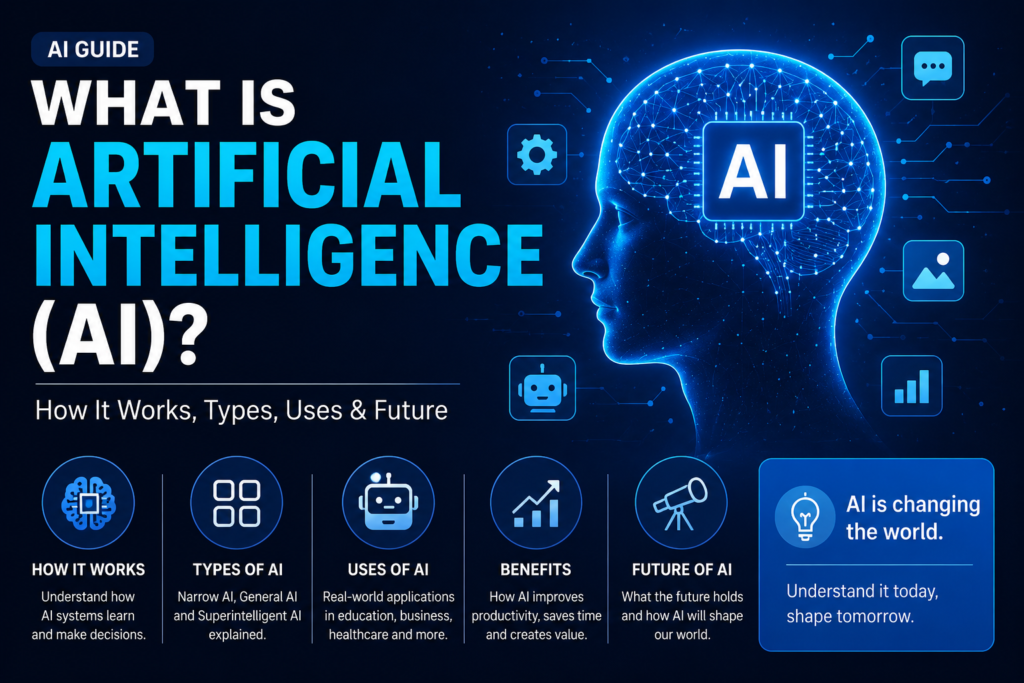
Artificial Intelligence, commonly called AI, is a technology that allows computers and software to perform tasks that normally require human intelligence.
These tasks can include understanding language, recognizing images, finding patterns, making predictions, generating content and helping people solve problems.
In simple words, AI helps computers learn from information and use that information to produce useful results.
You may already use AI every day without realizing it. Search engines, voice assistants, recommendation systems, translation tools, spam filters, navigation apps and many modern applications use different forms of artificial intelligence.
AI is no longer limited to research laboratories. It is now becoming part of everyday technology used by students, businesses, creators, developers and ordinary smartphone users.
How Does AI Work?
AI systems generally work by processing large amounts of information and identifying patterns within that information.
A simplified AI process looks like this:
Data → Training → Pattern Recognition → Output
For example, imagine an AI system designed to recognize cats in pictures.
First, the system can be trained using many images. During training, the AI analyzes different characteristics and patterns in those images.
After learning from the examples, the system can examine a new image and estimate whether it contains a cat.
Modern AI systems can perform much more complicated tasks, including understanding text, generating images, analyzing documents and answering questions.
The exact way an AI system works depends on the technology behind it.
What Are the Main Types of AI?
Artificial Intelligence can be discussed in different ways, but one common classification is based on its capabilities.
1. Narrow AI
Narrow AI is designed to perform specific tasks.
Most AI applications people use today fall into this category.
Examples include:
- Voice assistants
- Recommendation systems
- Image recognition
- Translation software
- Spam detection
- Search algorithms
- AI writing tools
A narrow AI system can be very effective at its particular task, but that does not mean it can perform every type of human intellectual activity.
2. General AI
Artificial General Intelligence, often called AGI, refers to a theoretical type of AI that could perform a broad range of intellectual tasks at a human-like level.
Unlike a system designed for one specific purpose, AGI would theoretically be able to learn and solve many different types of problems.
AGI remains an area of research and discussion rather than something that should simply be assumed to already exist in everyday technology.
3. Superintelligent AI
Superintelligent AI is a hypothetical concept describing an AI system whose intellectual capabilities would significantly exceed those of humans across many areas.
This remains a theoretical idea and is commonly discussed in research, technology and science-fiction contexts.
What Are the Different Technologies Behind AI?
AI is a broad field that includes several related technologies.
Machine Learning
Machine Learning (ML) allows computer systems to learn patterns from data instead of relying only on manually written instructions for every situation.
Machine learning can be used for tasks such as:
- Recommendations
- Fraud detection
- Predictions
- Image classification
- Text analysis
- Customer behavior analysis
Deep Learning
Deep learning is a type of machine learning that uses neural networks with multiple layers.
It has become particularly important for tasks involving large amounts of complex information, such as images, audio and language.
Deep learning is used in many modern AI applications.
Generative AI
Generative AI is designed to create new content based on patterns learned from existing data.
Depending on the system, generative AI can produce:
- Text
- Images
- Audio
- Video
- Computer code
- Other forms of digital content
This technology has made AI much more accessible to everyday users because people can interact with many systems using simple natural-language instructions.
What Is AI Used For?
Artificial Intelligence has applications across many industries.
AI in Education
Students and teachers can use AI tools for:
- Explaining difficult concepts
- Creating study material
- Summarizing information
- Generating practice questions
- Language learning
- Research assistance
AI should be used as a learning aid rather than a replacement for understanding the subject.
AI in Business
Businesses use AI for many different purposes, including:
- Customer support
- Data analysis
- Marketing
- Automation
- Document processing
- Sales forecasting
- Recommendation systems
AI can help businesses handle repetitive tasks and analyze large amounts of information more quickly.
AI in Healthcare
AI is also being researched and used in healthcare-related applications.
Examples include:
- Medical image analysis
- Research
- Drug discovery
- Administrative automation
- Data analysis
Healthcare applications require appropriate professional oversight because AI-generated results can contain errors.
AI in Smartphones
Modern smartphones can use AI for features such as:
- Camera improvements
- Voice recognition
- Translation
- Personalized recommendations
- Photo organization
- Battery optimization
- Security features
This means many people interact with AI every day without specifically opening an AI application.
AI in Content Creation
AI tools can help creators with:
- Writing ideas
- Image generation
- Video editing
- Voice generation
- Brainstorming
- Social media content
- Design concepts
However, users should always review AI-generated content before publishing it.
What Are the Benefits of AI?
Artificial Intelligence can provide several advantages when used correctly.
1. Saves Time
AI can automate repetitive tasks and help users complete certain activities faster.
2. Handles Large Amounts of Data
AI systems can process and identify patterns in large datasets much faster than a person could manually.
3. Helps With Productivity
AI tools can assist with writing, planning, research, coding, analysis and other tasks.
4. Available Around the Clock
Many software-based AI services can operate continuously without normal working-hour limitations.
5. Personalized Experiences
AI can help applications provide personalized recommendations based on user behavior and preferences.
What Are the Limitations of AI?
AI is powerful, but it is not perfect.
One important limitation is that AI can produce incorrect information.
Depending on the system and task, AI may misunderstand a question, make an incorrect prediction or generate information that sounds convincing but is wrong.
Other challenges include:
- Privacy concerns
- Bias in data
- Security risks
- Incorrect outputs
- Dependence on data quality
- Lack of human judgment
- Copyright and ownership questions
For important decisions, AI output should be checked rather than accepted automatically.
Is AI Going to Replace Humans?
The answer is more complicated than simply saying yes or no.
AI can automate some tasks that humans currently perform. However, many jobs involve communication, judgment, creativity, physical work, leadership, responsibility and real-world decision-making that cannot be reduced to a single AI task.
In many cases, AI is more useful as a tool that helps people work faster rather than as a complete replacement for people.
The impact of AI will likely depend on how companies, workers, governments and individuals choose to use the technology.
How Can Beginners Start Learning AI?
You do not need to become a programmer to start understanding AI.
A beginner can start with these steps:
Step 1: Understand the Basics
Learn basic concepts such as AI, machine learning, deep learning and generative AI.
Step 2: Try AI Tools
Use AI applications for simple tasks such as writing, brainstorming, summarizing and learning.
Step 3: Learn Better Prompting
Learn how to give clear instructions to AI systems.
A good prompt usually explains:
- What you want
- The context
- The format
- Any important limitations
Step 4: Verify Information
Never assume that every AI-generated answer is automatically correct.
Step 5: Learn Continuously
AI technology changes quickly, so keeping up with new tools and developments can be useful.
What Is the Future of AI?
Artificial Intelligence is likely to continue becoming more integrated into software, smartphones, businesses and online services.
Future developments may lead to more capable AI assistants, improved automation, better personalization and new ways of interacting with computers.
At the same time, important questions around privacy, security, employment, copyright, reliability and responsible AI use will remain important.
The future of AI will not only depend on how powerful the technology becomes, but also on how responsibly people use it.
Frequently Asked Questions About AI
What is AI in simple words?
AI is technology that allows computers and software to perform tasks that normally require some form of human intelligence, such as recognizing patterns, understanding language or generating content.
What does AI stand for?
AI stands for Artificial Intelligence.
How does artificial intelligence work?
AI systems process data and use algorithms and trained models to identify patterns and produce outputs such as predictions, classifications, recommendations or generated content.
Is AI difficult to learn?
Basic AI concepts are relatively easy to learn for beginners. More advanced areas such as machine learning and AI development require programming, mathematics and technical knowledge.
Can AI make mistakes?
Yes. AI systems can produce incorrect, incomplete or misleading results. Important information should always be verified.
Is AI useful for students?
AI can help students understand concepts, organize information, practice skills and generate study material, but students should use it as a learning aid rather than simply copying answers.
What is Generative AI?
Generative AI refers to AI systems that can create new content such as text, images, audio, video or code based on instructions and learned patterns.
Final Thoughts
Artificial Intelligence is one of the most important technologies shaping modern computing.
From smartphones and search engines to business software and content creation tools, AI is already being used in many areas of everyday life.
Understanding what AI is, how it works, what it can do and where its limitations are can help you make better decisions when using AI technology.
Whether you are a student, creator, business owner or simply interested in technology, learning the basics of AI is a useful starting point for understanding the future of technology.