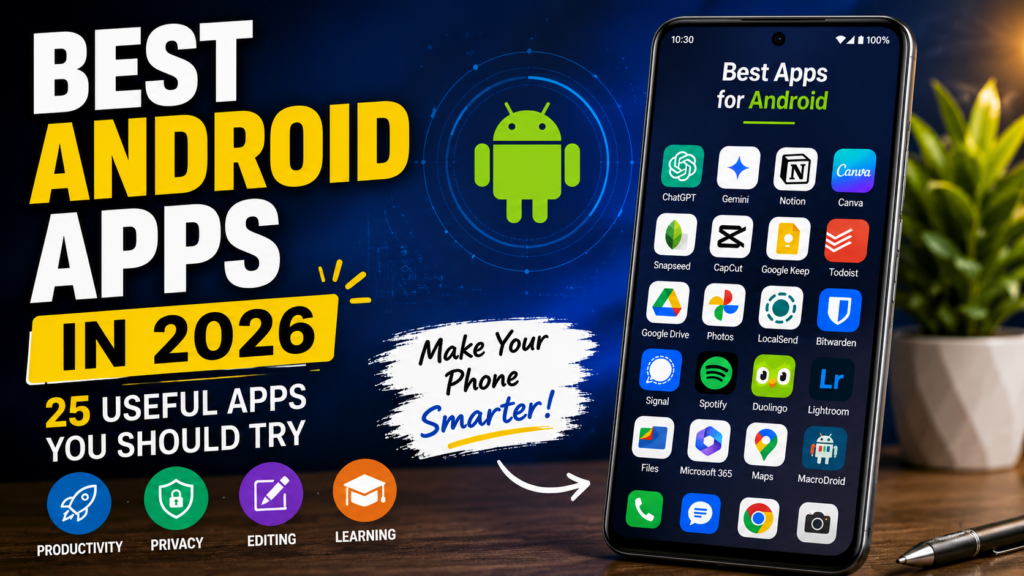
Best Android Apps in 2026: 25 Useful Apps You Should Try
Android phones can do much more than calling, messaging and watching videos. With the right apps, your smartphone can become a powerful tool for work, study, entertainment, creativity, communication and even artificial intelligence.
But the Google Play Store has millions of apps, and finding genuinely useful apps can be difficult. Many apps look impressive at first but are filled with ads, unnecessary permissions or features you may never use.
In this guide, we have selected some of the most useful types of Android apps to explore in 2026. Whether you want to use AI, improve productivity, edit photos, protect your privacy or simply get more from your phone, these apps are worth checking out.
1. AI Apps for Android
Artificial intelligence has become one of the biggest trends in mobile apps.
AI apps can help with writing, research, brainstorming, summarizing information, generating images, learning new topics and completing everyday tasks.
Modern AI assistants can understand natural language, making it easier to ask questions without searching through multiple menus.
What Can You Use AI Apps For?
- Writing and rewriting text
- Summarizing information
- Generating ideas
- Learning difficult topics
- Creating images
- Translating languages
- Planning tasks
- Brainstorming content
AI is also becoming more deeply integrated into Android apps and devices, making this category one of the most important areas to watch.
2. Productivity Apps
A good productivity app can turn your smartphone into a personal workspace.
Productivity apps are useful for creating to-do lists, managing tasks, writing notes, organizing projects and keeping track of important information.
Instead of keeping everything in your memory, you can use a productivity app to organize your day.
Useful Productivity Features
- To-do lists
- Reminders
- Notes
- Calendar integration
- Task management
- Project planning
- Document organization
For students, professionals, freelancers and business owners, productivity apps can make everyday work much easier.
3. Note-Taking Apps
If you frequently write down ideas, important information or daily tasks, a good note-taking app is essential.
Modern note apps are much more powerful than simple text editors. Many allow users to organize notes into folders, add images, create checklists and search through old information quickly.
What Can You Use Note Apps For?
- Study notes
- Business ideas
- Shopping lists
- Meeting notes
- Travel plans
- Content ideas
- Daily planning
The best note-taking system is usually the one that is simple enough for you to use every day.
4. Photo Editing Apps
You don’t always need a computer to create good-looking photos.
Modern Android photo editors provide tools for cropping, resizing, adjusting brightness, improving colors, removing unwanted objects and applying creative effects.
Photo editing apps are particularly useful for social media creators, online sellers and people who regularly upload pictures.
Useful Photo Editing Features
- Background removal
- Object removal
- AI editing
- Filters
- Color adjustment
- Image resizing
- Text tools
- Collage creation
For quick edits, a smartphone can now handle many tasks that previously required desktop software.
5. Video Editing Apps
Short-form videos have made mobile video editing extremely popular.
Android video editors allow users to cut clips, add music, captions, transitions, effects and animations directly from a smartphone.
What Can You Create?
- YouTube videos
- Instagram Reels
- Short videos
- Product videos
- Business advertisements
- Travel videos
- Educational content
If you regularly create content, learning one good mobile video editor can be more useful than installing dozens of different editing apps.
6. Cloud Storage Apps
Cloud storage apps are useful for keeping important files available across multiple devices.
Instead of storing everything only on your phone, you can upload documents, photos and other files to cloud storage.
This can also help when you change your phone or accidentally lose a device.
Cloud Storage Is Useful For
- Photos
- Videos
- Documents
- Work files
- Backups
- Shared files
Always check how much storage you receive and review the privacy settings before uploading sensitive information.
7. Password Manager Apps
Using the same password everywhere is a bad security habit.
Password manager apps can help you create and store strong, unique passwords so you don’t have to remember every password manually.
A Password Manager Can Help Organize
- Website passwords
- App passwords
- Secure notes
- Login information
- Important account details
For better security, use a strong master password and enable two-factor authentication whenever it is available.
8. Privacy and Security Apps
Your smartphone contains a huge amount of personal information.
Photos, messages, contacts, location data, documents and login information can all be stored on your phone. This makes privacy and security extremely important.
Before installing any app, check the permissions it requests.
For example, a simple calculator should not normally need access to your contacts, microphone or location.
Good Android Security Habits
- Install apps from trusted sources
- Review app permissions
- Keep Android updated
- Use a screen lock
- Enable two-factor authentication
- Remove apps you no longer use
- Avoid suspicious APK files
9. File Manager Apps
A good file manager can make it much easier to find and organize files on your phone.
Depending on your device, you may have folders containing downloads, documents, screenshots, videos and other files.
Useful File Manager Features
- Find files quickly
- Rename files
- Move files
- Delete unwanted files
- Create folders
- Share documents
- Check storage usage
File managers are especially useful for people who frequently download documents, videos or other large files.
10. PDF Reader Apps
PDF files are everywhere, from school documents and invoices to manuals and business reports.
A PDF reader allows you to open documents directly on your smartphone without using a computer.
Useful PDF Features
- Search inside PDFs
- Highlight text
- Add comments
- Fill forms
- Sign documents
- Share files
- Organize documents
If you regularly work with documents, keeping a reliable PDF app installed can save time.
11. Language Learning Apps
Learning a new language is easier when you can practice for a few minutes every day.
Language learning apps can help users improve vocabulary, pronunciation, grammar and listening skills.
The biggest advantage is convenience. You can practice while traveling, during breaks or whenever you have a few free minutes.
For better results, combine an app with real conversations, reading and listening practice.
12. Keyboard Apps
Your keyboard is one of the most frequently used parts of your smartphone.
A good keyboard can improve typing speed and provide useful features such as autocorrect, voice typing, multilingual typing, emojis and text suggestions.
Before installing a third-party keyboard, pay close attention to its privacy policy and permissions because keyboards can potentially handle sensitive text.
13. Communication Apps
Messaging and communication apps remain essential on almost every smartphone.
Common Communication Features
- Text messaging
- Voice calls
- Video calls
- Group chats
- File sharing
- Voice messages
- Communities
Always keep communication apps updated because security and privacy improvements are frequently included in newer versions.
14. Navigation and Travel Apps
Your Android phone can replace many traditional travel tools.
Navigation apps can help with directions, traffic information, public transportation and finding nearby places.
Travel Apps Can Help With
- Maps
- Directions
- Hotel searches
- Flight information
- Currency conversion
- Translation
- Local recommendations
Downloading important maps or travel information before a trip can also be useful when your internet connection is unreliable.
15. Health and Fitness Apps
Fitness apps can help users keep track of daily activity and build healthier routines.
Common Fitness Tracking Features
- Steps
- Exercise
- Running
- Cycling
- Sleep
- Water intake
- Workout routines
The most useful fitness app is one that encourages consistent habits rather than simply collecting large amounts of data.
16. Expense and Budget Apps
Managing money can become easier when your expenses are organized.
Budget apps can help you record spending, categorize expenses and understand where your money is going.
Common Expense Categories
- Food
- Shopping
- Travel
- Bills
- Entertainment
- Business expenses
Regularly reviewing your spending can help you make better financial decisions.
Never give an app unnecessary access to banking information or financial accounts.
17. Shopping Apps
Shopping apps make it easier to compare products, check prices and track orders.
However, don’t install an app simply because it offers a discount.
Before Using a Shopping App, Check
- Developer information
- App reviews
- Required permissions
- Privacy policy
- Return and refund policies
Using trusted shopping platforms is generally safer than downloading unknown shopping APKs.
18. Social Media Apps
Social media apps continue to be an important part of mobile usage.
They allow people to communicate, share photos and videos, discover content and build communities.
Social Media Can Be Useful For
- Promoting products
- Building an audience
- Publishing videos
- Communicating with customers
- Studying trends
- Driving traffic to a website
However, managing screen time is important because social media apps are designed to keep users engaged.
19. Screen Recording Apps
Android devices increasingly include built-in screen recording features.
Screen recording is useful for creating tutorials, demonstrating an app, recording gameplay or explaining a problem to someone.
Before installing a third-party screen recorder, check whether your phone already includes the feature.
20. QR and Barcode Scanner Apps
QR codes are now common in restaurants, payments, websites, tickets and product packaging.
Many modern Android phones can scan QR codes directly through the camera.
If you use a third-party scanner, make sure it comes from a trusted developer and doesn’t request unnecessary permissions.
Never open a QR code blindly if you don’t know where it leads.
21. Backup Apps
Losing a smartphone can be stressful, especially when important photos and documents are stored only on the device.
Backup tools can help protect your important information.
Important Things to Back Up
- Photos
- Contacts
- Documents
- Messages
- Device settings
- Important files
A backup is only useful if it actually works, so check your backup settings regularly.
22. Reading and News Apps
If you enjoy reading, news and magazine apps can turn your phone into a portable reading device.
You can use them to follow technology, business, sports, science, entertainment and world news.
Try to use reliable sources and avoid believing headlines without checking the full story.
23. Learning and Education Apps
Your smartphone can also become a powerful learning tool.
Education apps cover subjects ranging from mathematics and science to programming, business and languages.
Students Can Use Apps For
- Revision
- Flashcards
- Practice tests
- Online courses
- Note-taking
- Research
The key is consistency. Even a short focused learning session every day can be more useful than several hours of irregular study.
24. Utility Apps
Utility apps are simple tools that solve specific problems.
Examples of Useful Utilities
- Document scanners
- Unit converters
- Calculators
- Clipboard tools
- Storage analyzers
- QR scanners
- PDF tools
You don’t need hundreds of utility apps. A small collection of reliable tools is usually enough.
25. AI-Powered Everyday Apps
One of the biggest changes in Android apps is the growing use of artificial intelligence.
AI is moving beyond simple chatbots and appearing in writing tools, photo editors, search, productivity apps, translation and other everyday experiences.
The important thing is not whether an app has an “AI” label.
Ask One Simple Question
Does the AI actually make the app more useful?
A good AI feature should save time, improve results or make a difficult task easier.
How to Choose the Right Android Apps
You don’t need to install every app you see in an online list.
Before installing an app, ask yourself:
- Do I actually need this app?
- Is it from a trusted developer?
- Does it have good reviews?
- What permissions does it request?
- Is it regularly updated?
- Does it contain excessive advertisements?
- Does the privacy policy make sense?
- Is there already a built-in Android feature that does the same thing?
These simple checks can help you avoid unnecessary or suspicious apps.
Are Free Android Apps Safe?
Not every free app is bad, but “free” does not automatically mean safe.
Some free apps make money through advertising, subscriptions or other business models.
Before installing an unfamiliar app, check its developer, reviews, permissions and update history.
Be especially careful with modified APK files and apps downloaded from unknown websites.
Final Thoughts
The best Android apps are not necessarily the apps with the most features.
A good app should solve a real problem, be easy to use and provide enough value to justify keeping it on your phone.
In 2026, AI, productivity, privacy, security, photo editing and cloud services are becoming increasingly important parts of the Android experience.
Instead of filling your phone with dozens of applications, choose a smaller collection of reliable apps that genuinely make your daily life easier.
Your smartphone is already a powerful computer. The right apps simply help you use that power better.
Frequently Asked Questions
What are the best Android apps in 2026?
The best Android apps depend on what you need. AI assistants, productivity tools, photo editors, cloud storage, security apps and learning apps are some of the most useful categories to explore.
Which Android apps are useful for productivity?
Task managers, note-taking apps, cloud storage tools, calendars and document apps can all improve productivity. The best combination depends on your daily work and personal routine.
Are free Android apps safe?
Many free apps are safe, but users should always check the developer, permissions, reviews and update history before installing an unfamiliar application.
Should I download Android apps from unknown websites?
It is better to use trusted app sources whenever possible. Unknown APK files can create unnecessary security and privacy risks.
Are AI apps useful on Android?
Yes. AI apps can help with writing, learning, brainstorming, research, image editing, planning and many other everyday tasks.
How many apps should I install on my Android phone?
There is no perfect number. Install the apps you genuinely use and remove applications that you no longer need. Keeping fewer unnecessary apps can also make your phone easier to manage.